

10 Things to Consider When Reading the Global SportsTech Report 2026
A new study released today by SportsPro and Sportradar — the inaugural Global SportsTech Report 2026 — lands at an interesting moment

A new study released today by SportsPro and Sportradar — the inaugural Global SportsTech Report 2026 — lands at an interesting moment
A guy with a scarf is collaborating with Dolby OptiView - Enabling live sports experiences that engage and captivate fans. #ad
The inaugural Global SportsTech Report 2026, produced by SportsPro in partnership with Sportradar, arrives as the industry moves from AI experimentation to active deployment. The data is drawn from more than 160 senior executives across leagues, teams, broadcasters, media platforms, and venue operators worldwide. It is worth reading carefully, not only for the headline numbers, but for what the tensions between them reveal about where the industry actually is.
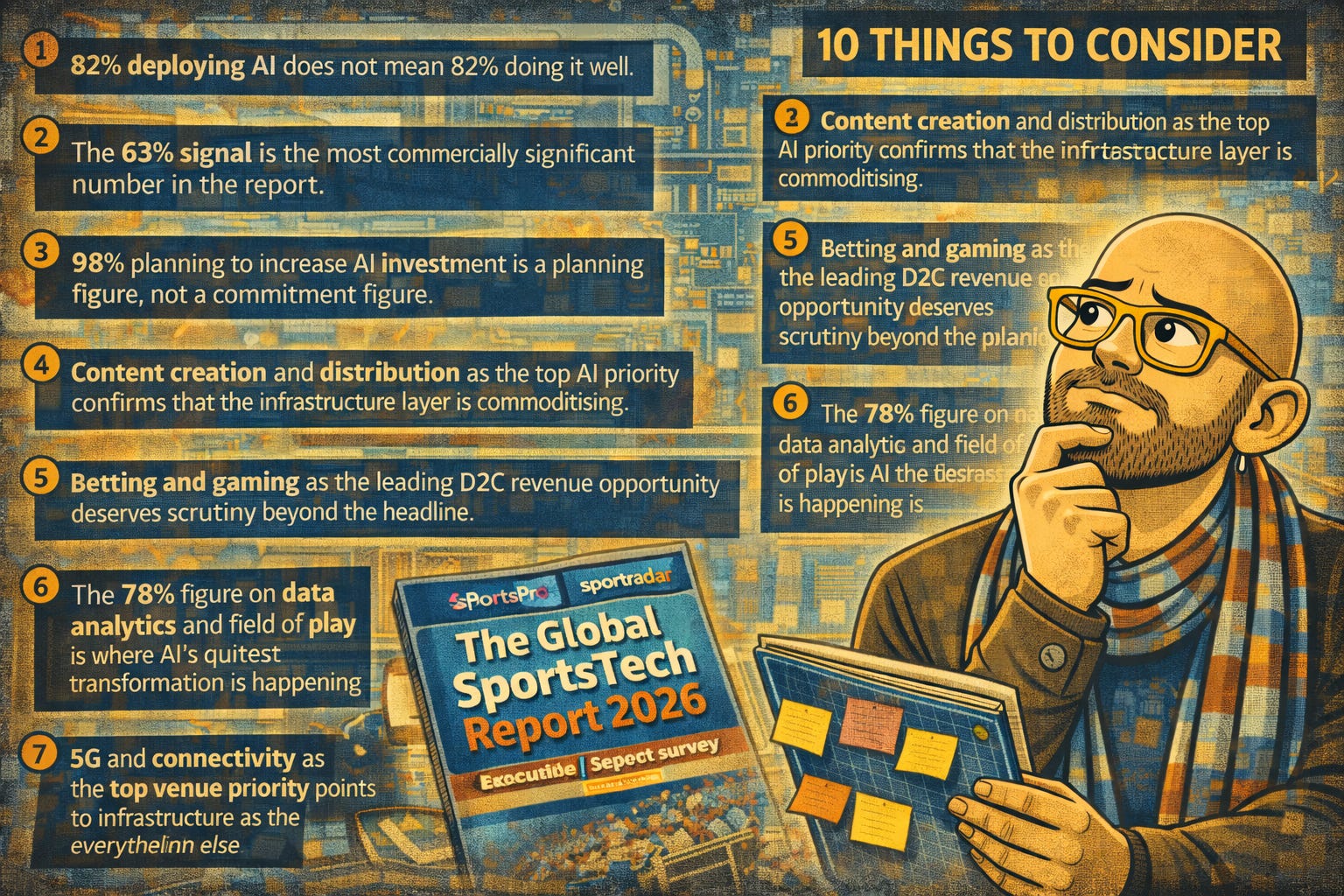
1. 82% deploying AI does not mean 82% doing it well
The proportion of sports organisations currently deploying AI is high. The proportion that have defined governance, editorial accountability, and quality control frameworks for those deployments is likely far lower. Deployment and maturity are different conditions, and conflating them leads to misaligned expectations on both the vendor and client side.
2. The 63% signal is the most commercially significant number in the report
While 80% of respondents think the technology industry is well-equipped to serve sport, 63% say more sports-specific technologies are required to achieve their goals. These two figures belong together. They indicate a market that acknowledges general capability while identifying a structural gap in contextual depth. For vendors, this is both a diagnostic and a positioning opportunity.
3. 98% planning to increase AI investment is a planning figure, not a commitment figure
Investment intentions at this scale reflect confidence and momentum, not contracted budgets. The distance between stated intention and actual procurement is shaped by governance cycles, rights complexity, internal alignment, and economic conditions. Vendors should read this as a direction indicator, not a pipeline.
4. Content creation and distribution as the top AI priority confirms that the infrastructure layer is commoditising
73% of organisations planning to expand AI use intend to do so in content creation and distribution. Automated highlights, multilingual commentary, metadata generation, and content adaptation are moving from differentiation to baseline expectation. The real competitive terrain is in the production layer above: editorial judgment, personalisation depth, and the quality of insight extracted from data.
5. Betting and gaming as the leading D2C revenue opportunity deserves scrutiny beyond the headline
31% view betting and gaming as the D2C revenue stream with the greatest opportunity, the highest of any category. This reflects both the maturity of that commercial relationship and the regulatory and reputational complexity that accompanies it. Sports organisations pursuing this path need clarity on where the commercial relationship ends and the integrity risk begins.
6. The 78% figure on data analytics and field of play is where AI’s quietest transformation is happening
While media and fan experience dominate the report’s narrative, the finding that 78% of respondents believe advanced data analytics will have the most significant impact on athletic performance deserves equal attention. This is the part of AI’s role in sport that generates less content but creates more durable competitive and commercial change over time.
7. 5G and connectivity as the top venue priority points to infrastructure as the precondition for everything else
57% identify enhanced 5G and Wi-Fi connectivity as the technology with the most potential to transform the at-venue experience. This is not a consumer feature request. It is an acknowledgment that physical presence remains sport’s most defensible engagement moment, and that the digital layer on top of it depends entirely on reliable, high-capacity infrastructure.
8. The report’s sponsorship context matters
Sportradar is both the report’s research partner and one of the industry’s largest sports technology companies operating across data, media, betting, and integrity services. The findings are credible and the methodology appears sound. Reading with awareness of the source context helps distinguish between observations that reflect broad industry reality and those that may align with Sportradar’s commercial positioning.
9. The democratisation argument in the report’s conclusion is the longest-horizon claim and deserves the most testing
The suggestion that more affordable AI and mobile technology will bring the benefits of this transformation to millions more people globally is compelling. It is also the claim most dependent on infrastructure investment, regulatory alignment, and rights access in markets where those conditions are still being established. It is worth monitoring how this unfolds rather than assuming it as an outcome.
10. An inaugural report establishes a baseline, not a trend
This is the first edition of what should become an annual reference document. Its greatest value may be retrospective: the 2027 edition will show whether the 98% investment intention translated into deployment, whether the 63% gap in sports-specific technology has narrowed, and whether content creation AI has moved from efficiency tool to genuine editorial differentiator. File the numbers now and return to them.
The Global SportsTech Report 2026 is available at sportspro.com